Talmud Readings Fir Death of a Father
Decease
Care for the Dead
Burial in Jewish Cemetery
Mourning Practices
Kaddish
Tombstones
Decease
In Judaism, life is valued above almost all else. The Talmud notes that, since all flesh is descended from a single person, taking a life is like destroying an entire world while saving a life is like saving an entire world.
Decease, however, is not viewed as a tragedy, even when it occurs early on in life or through unfortunate circumstances. Death is seen as a natural process. Death, like life, has meaning and is part of a divine plan. In addition, Jews accept a firm belief in an afterlife where those who have lived a worthy life will be rewarded.
Where death is imminent and the patient is suffering, Jewish law does allow one to end artificially prolonging life. Thus, in certain circumstances, Jewish law permits "pulling the plug" or refusing boggling means of prolonging life.
Mourning practices in Judaism are all-encompassing, but they are not an expression of fear or distaste for death. Jewish practices relating to decease and mourning have two purposes: to evidence respect for the expressionless (kavod ha-met), and to condolement the living (nihum avelim), who will miss the deceased.
Care for the Expressionless
Subsequently a person dies, the eyes are closed, the trunk is laid on the floor and covered, and candles are lit next to the torso. The body is never left alone until after burial, as a sign of respect. The people who sit with the dead body are chosen shomerim, from the root Shin-Mem-Resh, meaning "guards" or "keepers".
Respect for the dead torso is a matter of paramount importance. For case, the shomerim may not eat, beverage, or perform a commandment in the presence of the dead. To do so would be considered mocking the expressionless, because the expressionless can no longer do these things.
Most communities have an system to treat the dead, known as the chevra kaddisha (the holy society). These people are volunteers. Their work is considered extremely meritorious, because they are performing a service for someone who can never repay them.
Autopsies in full general are discouraged as desecration of the body. They are permitted, withal, where information technology may save a life or where local law requires it. When autopsies must exist performed, they should be minimally intrusive.
The presence of a expressionless body is considered a source of ritual impurity. For this reason, a Kohein may not be in the presence of a corpse. People who have been in the presence of a body wash their hands before entering a home. This is to symbolically remove spiritual impurity, not physical uncleanness: it applies regardless of whether yous have physically touched the body.
In grooming for the burial, the trunk is thoroughly cleaned and wrapped in a unproblematic, apparently linen shroud. The Sages decreed that both the dress of the body and the coffin should be simple, so that a poor person would non receive less honor in death than a rich person. In the case of men, the torso is wrapped in a tallit with its tzitzit rendered invalid. The body is non embalmed, and no organs or fluids may be removed.
The body must not be cremated. It must be cached in the world. Coffins are not required, merely if they are used, they must have holes drilled in them so the body comes in contact with the earth.
The body is never displayed at funerals; open casket ceremonies are forbidden by Jewish law. According to Jewish police, exposing a body is considered disrespectful, because it allows not only friends, but also enemies to view the expressionless, mocking their helpless land.
Jewish law requires that a tombstone be prepared, and so that the deceased will not be forgotten and the grave volition non be desecrated. It is customary in some communities to keep the tombstone veiled, or to delay in putting it up, until the finish of the 12-month mourning period. The idea underlying this custom is that the expressionless will non be forgotten when he is being mourned every day. In communities where this custom is observed, there is generally a formal unveiling ceremony when the tombstone is revealed.
Burying in a Jewish Cemetery
The establishment of a dissever identify for the burial of Jews, although an aboriginal practice, is not mandated directly in the Bible or Talmud or in the codes of Jewish law. The Bible (Genesis 23) describes the conquering by Abraham of a private plot to bury his wife Sarah, and the Talmud also calls for burial in one'due south own family plot (b'tock shelo) (Bava Batra 112a).
In Talmudic times, while ancestral tombs continued to exist used, public burial plots were already established. In one reference, the Talmud suggests that a righteous man cannot be buried side by side to a sinner, which would point that burying in communal cemeteries did take place. The sinner the Talmud speaks of is one guilty of a majuscule criminal offense, which includes the worship of idols. Since idolatry was prevalent amid non-Jews, all heathens-and past extension all not-Jews, were placed in the aforementioned category. This is probably the rabbinic foundation for insisting that Jews be buried in their own cemeteries.
In theory and in emergencies, however, the law does permit a Jew to be buried next to a non-Jew. Rabbi Yekutiel Greenwald, in his book on morning time, mentions the case of a Jew who lived among non-Jews and feared that when he died he would be buried in their cemetery. The Jew therefore left word that when he died his body was to be burned. When the man'south wish became known, the rabbis ruled that the wish was not to be fulfilled because it is far better to be buried among non-Jews than to exist cremated, which is a articulate violation of Jewish police force.
During Earth War II, the law committee of the Jewish Welfare Board's Division of Religious Activities, consisting of all denominations of rabbis, ruled that Jewish chaplains may officiate at military services in national cemeteries such as Arlington, where Jewish and Christian soldiers are buried side by side.
Mourning Practices
Jewish mourning practices tin exist broken into several periods of decreasing intensity. These mourning periods allow the full expression of grief, while discouraging excesses of grief and allowing the mourner to gradually return to a normal life.
When a close relative (parent, sibling, spouse or kid) beginning hears of the death of a relative, information technology is traditional to express the initial grief by fierce one's clothing. The tear is fabricated over the middle if the deceased is a parent, or over the right side of the chest for other relatives. This fierce of the vesture is referred to every bit keriyah (lit. "fierce"). The mourner recites the blessing describing G-d as "the truthful Judge," an acceptance of Grand-d'south taking of the life of a relative.
From the time of death to the burial, the mourner's sole responsibility is caring for the deceased and preparing for the burial. This period is known as aninut. During this time, the mourners are exempt from all positive commandments ("thou shalts"), because the preparations take starting time priority. This catamenia usually lasts a 24-hour interval or 2; Judaism requires prompt burying.
During this aninut period, the family should be left alone and allowed the total expression of grief. Condolence calls or visits should not exist made during this fourth dimension.
After the burial, a close relative, near neighbor or friend prepares the get-go repast for the mourners, the se'udat havra'ah (repast of condolence). This meal traditionally consists of eggs (a symbol of life) and breadstuff. The meal is for the family only, not for visitors. After this time, condolence calls are permitted.
The next menses of mourning is known as shiva (7, because it lasts vii days). Shiva is observed by parents, children, spouses and siblings of the deceased, preferably all together in the deceased'southward home. Shiva begins on the day of burial and continues until the morn of the seventh day after burial. Mourners sit down on depression stools or the floor instead of chairs, do not wearable leather shoes, exercise not shave or cutting their pilus, do not vesture cosmetics, do not work, and practise not practise things for comfort or pleasure, such as breast-stroke, have sex, put on fresh clothing, or report Torah (except Torah related to mourning and grief). Mourners wear the clothes that they tore at the time of learning of the decease or at the funeral. Mirrors in the business firm are covered. Prayer services are held where the shiva is held, with friends, neighbors, and relatives making up the minyan (a quorum of ten Jews – for Orthodox Jews, x males – above historic period thirteen).
The Sabbath that occurs during the shiva period counts toward the seven days of shiva, but is not observed as a mean solar day of mourning. If a festival occurs during the mourning catamenia, the mourning is terminated, but if the burial occurs during a festival, the mourning is delayed until subsequently the festival.
The next period of mourning is known equally shloshim (thirty, because it lasts until the 30th day subsequently burial). During that period, the mourners do non attend parties or celebrations, do not shave or cut their hair, and practise non listen to music.
The final period of formal mourning is avelut, which is observed only for a parent. This period lasts for twelve months subsequently the burial. During that time, mourners avert parties, celebrations, theater and concerts. For eleven months of that period, starting at the fourth dimension of burial, traditionally the son of the deceased recites the mourner's Kaddish every twenty-four hours. Today, many daughters also recite the Kaddish.
Later the avelut menstruation is consummate, the family of the deceased is not permitted to go on formal mourning; even so, there are a few continuing acknowledgments of the decedent. Every yr, on the ceremony of the death, family members observe the deceased'due south Yahrzeit (Yiddish, lit. "ceremony"). Sons recite Kaddish and take an aliyah (anoint the Torah reading) in synagogue if possible. Mourners light a candle in honor of the decedent that burns for 24 hours. In addition, during services on Yom Kippur, Shemini Atzeret, the last day of Passover, and Shavuot, afterward the haftarah reading in synagogue, shut relatives recite the mourner's prayer, Yizkor ("May He remember...") in synagogue. Yahrzeit candles are also lit on those days.
When visiting a mourner, a invitee should not endeavor to limited grief with standard, shallow platitudes. The invitee should allow the mourner to initiate conversations. One should not divert the chat from talking about the deceased; to practise and so would limit the mourner'south ability to fully express grief, which is the purpose of the mourning period. On the reverse, the caller should encourage conversation nearly the deceased.
When leaving a house of mourning, it is traditional for the guest to say, "May the Lord comfort you with all the mourners of Zion and Jerusalem."
Kaddish
Kaddish is commonly known as a mourner's prayer, merely in fact, variations on the Kaddish prayer are routinely recited at many other times, and the prayer itself has zip to do with expiry or mourning. The prayer begins "May His keen Proper noun grow exalted and sanctified in the earth that He created as He willed. May He give reign to His kingship in your lifetimes and in your days ..." and continues in much that vein. The real mourner'southward prayer is El Molai Rachamim, which is recited at grave sites and during funerals.
Why, then, is Kaddish recited by mourners?
After a great loss like the decease of a parent, you lot might look a person to lose organized religion in M-d, or to cry out against K-d's injustice. Instead, Judaism requires a mourner to stand up up every day, publicly and reaffirm faith in G-d despite this loss. To do and so inures to the merit of the deceased in the eyes of Thousand-d, considering the deceased must have been a very good parent to raise a child who could express such faith in the face of personal loss. Kaddish can only be said if a minyan is available.
Why is Kaddish recited for merely 11 months, when the mourning menstruum is 12 months? Co-ordinate to Jewish tradition, the soul must spend some time purifying itself before it can enter sky. The maximum fourth dimension required for purification is 12 months for the evilest person. To recite Kaddish for 12 months would imply that the parent was the blazon who needed 12 months of purification. To avert this implication, the Sages decreed that a son should recite Kaddish for simply xi months.
A person is permitted to recite Kaddish for other shut relatives as well every bit parents, but simply if his parents are dead.
Tombstones
Jewish law requires that a tombstone be prepared, so that the deceased will not exist forgotten and the grave volition non be desecrated. It is customary in some communities to keep the tombstone veiled, or to delay in putting it upwardly, until the stop of the 12-calendar month mourning period. The idea underlying this custom is that the dead will not be forgotten when he is being mourned every day. In communities where this custom is observed, at that place is generally a formal unveiling anniversary when the tombstone is revealed.
Information technology is also customary in some communities to place small stones on a gravesite when visiting it. This custom has become well-known from the pic Schindler'due south List, in which the children of survivors place stones on the grave of Oscar Schindler. The custom is non universal, fifty-fifty among traditional Jews, and at that place seems to exist some doubt every bit to how information technology originated. Information technology seems to have superstitious origins. It's a trivial similar leaving a calling carte du jour for the dead person, to let them know you were there. Stones, unlike flowers, are permanent and do not get diddled away in the air current. Some other sources suggest that it was originally done because we are required to erect a tombstone, and tombstones that really looked similar tombstones tended to become desecrated.
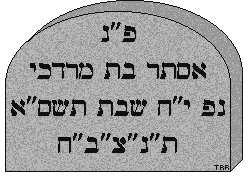
What is written on a tombstone? In most cases, it is very straightforward Hebrew text, similar to what you might see on a tombstone in English. An illustration of a typical Jewish tombstone is shown hither.
At the top is the abbreviation Peh-Nun, which stands for either "poh nitman" or "poh nikbar," which means "hither lies..." The marks that expect similar quotation marks are usually used to indicate an abbreviation or a number written in letters.
The side by side line is the name of the decedent, in the form (decedent's name), son of or daughter of [father's proper name]. "Son of" is either ben (Bet-Final Nun) or bar (Bet-Resh). "Girl of" is bat (Bet-Tav). The tombstone above says, "Esther bat Mordecai" (Elsie, daughter of Morrice). If one of the names is preceded past the letter Resh, this indicates that the person is a rabbi. The names may likewise exist followed by the championship ha-Kohein (Heh-Kaf-Heh-Final Nun) or ha-Levi (Heh-Lamed-Vav-Yod), indicating that the person was a Kohein or a Levite. See the Hebrew Alphabet page if y'all demand help in identifying specific letters on a tombstone.
The third line indicates the date of death. This line begins with the abridgement Nun-Peh followed by the date, the calendar month, and the year. The engagement and year are written in Hebrew numerals, which are letters. The calendar month name is sometimes preceded by a Bet (meaning "of"). The tombstone above indicates that the date of death was 18 Shevat 5761. Yod-Chet = 10+8 = 18. Shin-Bet-Tav is the month proper noun Shevat. Tav-Shin-Samech-Alef = 400+300+60+1 = 761 (the 5000 is causeless). See Hebrew Alphabet -Numerical Values if yous demand assistance in identifying a number. See Jewish Agenda - Months of the Jewish Year if you need help identifying months.
The last line is an abbreviation that stands for "tehe nishmatah tzerurah bitzror hachayim," which means "may her soul be bound in the bond of eternal life."
You may also find Jewish symbols on a tombstone, such as a menorah, a Magen David, a Torah roll, a king of beasts, or the two tablets of the Ten Commandments. Most of these symbols don't tell you anything virtually the decedent (other than the fact that he or she was Jewish). However, if you see a picture of easily in a position similar the one at right, this commonly indicates that the decedent was a Kohein, because this mitt position is used when the kohanim bless the congregation at certain times of the yr [this is where Leonard Nimoy, himself a Jew, got the idea for the "Live long and prosper" salute in Star Trek.]
Sources: Judaism 101.
Alfred J. Kolatch,The Jewish Book of Why/The Second Jewish Book of Why. (NY: Jonathan David Publishers, 1989).
toliveranempon1992.blogspot.com
Source: https://www.jewishvirtuallibrary.org/death-and-mourning-in-judaism
0 Response to "Talmud Readings Fir Death of a Father"
Post a Comment